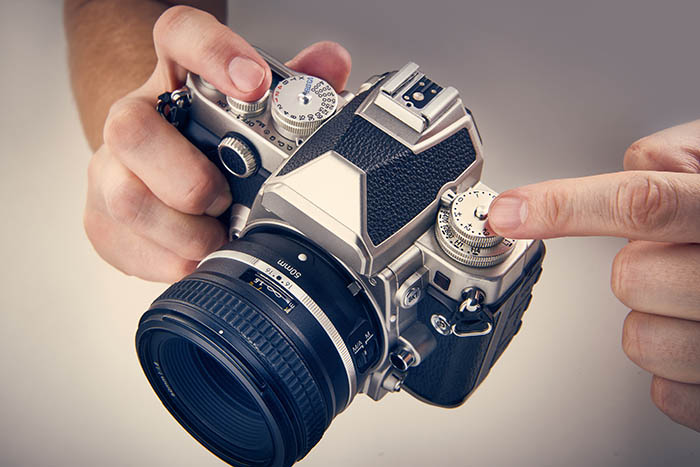
What Should You Learn First When You Buy a New Camera?
Buying a new camera is exciting. Whether you've moved from a smartphone to your first proper camera, upgraded from an older model or treated yourself to a much more advanced camera, there's a lot to discover.
The problem is that modern cameras can be very complicated.
Menus seem endless, there are dozens of buttons and settings, and the manual can leave you wondering whether you need a degree in photography just to take a decent picture!
The good news is that you don't need to learn everything.
In fact, trying to learn every setting at once is one of the quickest ways to become frustrated. The best approach is to concentrate on a few important things first and gradually build your knowledge.
Here are the areas I'd recommend concentrating on when you first get your new camera.
1. Learn How Your Camera Controls Exposure
The first thing to understand is how your camera controls the amount of light reaching the sensor.
There are three main settings:
- Aperture
- Shutter speed
- ISO
These three settings work together to produce the correct exposure.
But they also affect the appearance of your photograph.
Aperture controls how much of the scene is in focus and can give you that lovely blurred background often associated with portraits.
Shutter speed controls how motion is recorded. A fast shutter speed can freeze a moving subject, while a slower speed can introduce movement or blur.
ISO controls the camera's sensitivity to light and can be particularly useful when shooting in darker conditions.
You don't need to become an expert in all three immediately. Start by understanding what each one does and then experiment.
2. Understand Aperture
Aperture is one of the settings that can make an immediate difference to your photography.
You'll usually see it displayed as an f-number, such as f/2.8, f/4, f/8 or f/16.
The confusing part is that a smaller f-number means a larger aperture.
For example, f/2.8 gives you a much wider aperture than f/11.
A wide aperture can help isolate your subject against a blurred background, which is particularly useful for portraits, wildlife and detail photography.
A smaller aperture can give you more depth of field, which can be useful for landscapes and architecture.
Rather than simply memorising the numbers, experiment with your own camera and look at what actually changes in the photograph.
3. Learn About Shutter Speed
Shutter speed is particularly important if you photograph people, wildlife, sport, cars or anything else that moves.
A shutter speed of 1/1000 second can freeze fast action.
A shutter speed of 1/30 second is much slower and can introduce camera shake or subject movement.
There isn't one "correct" shutter speed. It depends entirely on what you're photographing.
One of the most useful things you can learn is to recognise when your shutter speed is too slow for the situation.
Once you understand that, you'll start making better decisions rather than simply hoping the camera gets it right.
4. Don't Ignore ISO
ISO is often the setting that beginners understand least, but it is extremely useful.
If you're shooting outdoors in good light, you might be able to use a low ISO such as 100 or 200.
As the light falls, increasing the ISO allows you to maintain a faster shutter speed or use a more suitable aperture.
The trade-off is that higher ISO settings can introduce more noise into your photographs.
Modern cameras are remarkably good at handling higher ISO settings, though, so don't be afraid to use ISO when you need it.
A slightly noisy photograph that is sharp is usually far better than a perfectly clean photograph ruined by camera shake.
5. Learn How Your Autofocus Works
Modern cameras have incredibly sophisticated autofocus systems.
They can recognise faces, eyes, animals, cars and other subjects, depending on the camera.
But having lots of autofocus options doesn't necessarily make things easier.
Start by learning:
- How to select a focus area
- How to focus on a particular subject
- How to use continuous autofocus
- How face and eye detection works
- When you should take control yourself
You don't need to understand every autofocus setting on day one.
Get comfortable with the basic system first and then explore the more advanced options as you need them.
6. Stop Changing Settings Without Knowing Why
This is something I see quite often when teaching photography.
Someone has watched a YouTube video suggesting a particular setting, changed it on their camera and then forgotten what they changed.
The result is that a few weeks later they're wondering why their camera isn't behaving as expected.
There is nothing wrong with experimenting, but try to understand why you're changing something.
If you change a setting, take a few photographs and see what difference it makes.
That way you're actually learning rather than simply collecting camera settings.
7. Learn to Look at Light
This is arguably more important than learning another camera setting.
A technically perfect photograph can still be a boring photograph if the light isn't interesting.
Start paying attention to:
- Where the light is coming from
- Whether the light is hard or soft
- The direction of shadows
- The time of day
- How the light changes your subject
Once you start looking at light, you'll begin to see potential photographs everywhere.
And that's when photography starts becoming much more interesting.
8. Don't Shoot Everything on Auto Forever
There's nothing wrong with using Auto while you're learning.
Your camera is a very sophisticated computer and it can do an excellent job.
The problem comes when you never move beyond it.
Learning to use modes such as Aperture Priority, Shutter Priority and Manual gives you much more control over the finished photograph.
You don't necessarily need to jump straight into Manual mode.
For many photographers, Aperture Priority is an excellent place to start because you can control the depth of field while allowing the camera to take care of the shutter speed.
9. Learn to Look at Your Photographs Critically
One of the best ways to improve is surprisingly simple:
Look at your photographs.
Not just the ones you like.
Look at the ones that didn't work and ask yourself why.
Was the subject out of focus?
Was the shutter speed too slow?
Was the background distracting?
Was the light poor?
Was the composition weak?
Once you start asking these questions, you'll begin to understand what you need to change next time.
That's how you improve much faster than simply taking hundreds of photographs without thinking about them.
10. Don't Try to Learn Everything at Once
This is probably the most important piece of advice I can give.
Your camera may have hundreds of different settings and functions.
You don't need to know what they all do.
Learn the things that will make the biggest difference to your photography first. Once you're comfortable with those, move on to something else.
Photography isn't about knowing every function hidden inside your camera.
It's about knowing which settings to use, when to use them and why.
Need a Little Help With Your New Camera?
If you've recently bought a new camera and are finding the controls and settings a little overwhelming, you're certainly not alone.
This is one of the reasons I offer 1-to-1 photography training. Rather than spending hours watching videos and trying to work out which advice applies to your particular camera, we can concentrate on the things you actually want to photograph.
Whether you're using a Fujifilm, Canon, Nikon, Sony or another camera system, the aim is to help you understand your camera and become more confident using it.
Sometimes a few hours of practical, hands-on training can save an awful lot of frustration.
And most importantly, you'll leave knowing how to use your camera rather than simply knowing where all the buttons are!
Want to Get More From Your New Camera?
If you've just bought a new camera and would like some help getting the best from it, one-to-one photography training can give you practical, hands-on guidance tailored to your camera and the type of photography you enjoy.