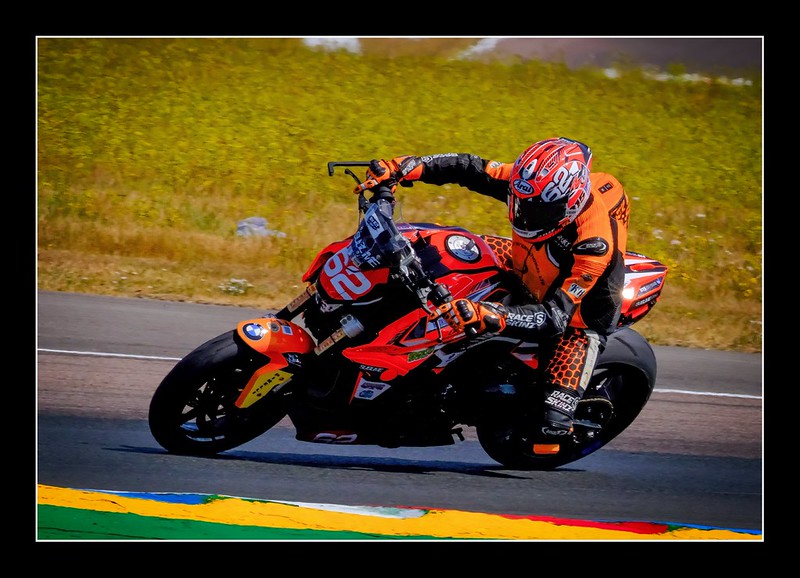
Motor Racing Photography at Thruxton – Getting the Most from Your Camera
There is something very satisfying about photographing motor racing. The combination of speed, noise, colour and split-second timing makes it one of the most challenging – and rewarding – types of photography.
Recently, we were back at Thruxton Circuit in Hampshire for another of our motor racing photography courses. With a full day of racing action, there was no shortage of opportunities to put the techniques into practice.
Whether you're using a Fujifilm, Canon, Nikon, Sony, Olympus or another camera system, the basic principles are much the same. The challenge is learning how to use your camera to capture not just the bikes and cars, but the feeling of speed and excitement that makes motorsport so enjoyable to photograph.
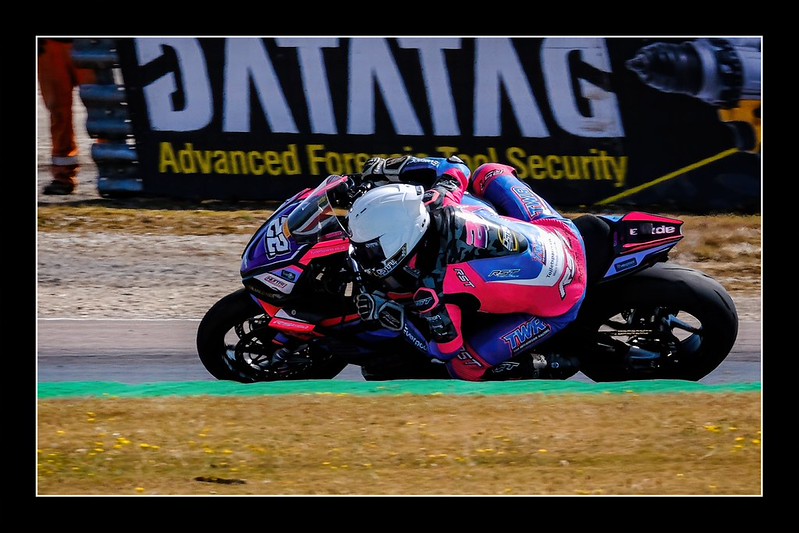
Capturing the action at Thruxton requires a combination of good positioning, camera technique and timing.
Getting the Shutter Speed Right
One of the first things we look at on a motor racing photography course is shutter speed.
It is tempting to use a very fast shutter speed to make sure everything is perfectly sharp. While this can produce excellent images, there is a downside: freeze the action completely and sometimes the photograph can look as though the bike or car is simply sitting on the track.
Using a slower shutter speed introduces movement into the photograph.
This is particularly effective when photographing bikes travelling across your field of view. By following the subject smoothly as it moves through the frame, the background becomes blurred while the bike remains relatively sharp.
This technique is known as panning, and when you get it right, it gives the photograph a much greater sense of speed.
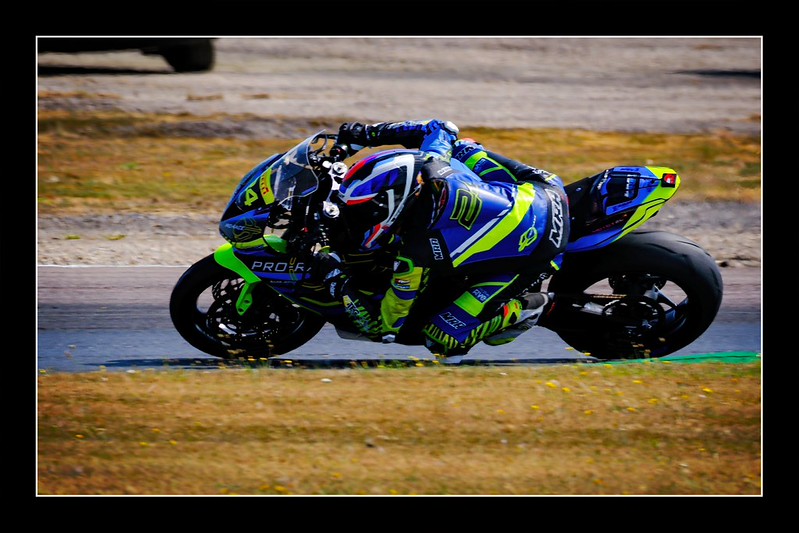
Panning can transform a straightforward racing photograph into an image that really conveys movement. The blurred background helps emphasise just how quickly the bike is travelling.
Mastering the Art of Panning
Panning is probably one of the most useful skills to learn if you want to improve your motorsport photography.
The principle is simple. As the bike approaches, you track it smoothly with the camera, press the shutter while continuing to follow the subject and then keep the camera moving through the exposure.
That last part is important.
A common mistake is to stop moving the camera as soon as the shutter is pressed. Continuing the movement helps maintain a smooth motion and increases the chance of getting a sharp subject with an attractive blurred background.
It doesn't always work – and that's part of the fun!
You might take several photographs and only get one or two that really work. With practice, however, your success rate will gradually improve.
And don't be afraid to experiment with different shutter speeds. A relatively fast shutter speed will give you a higher percentage of sharp images, while slowing things down can produce much more dramatic movement.
It's Not All About Perfectly Sharp Racing Shots
Although panning and freezing the action are important techniques, one of the great things about photographing motorsport is that you never quite know what you're going to see.
Occasionally something completely unexpected happens.
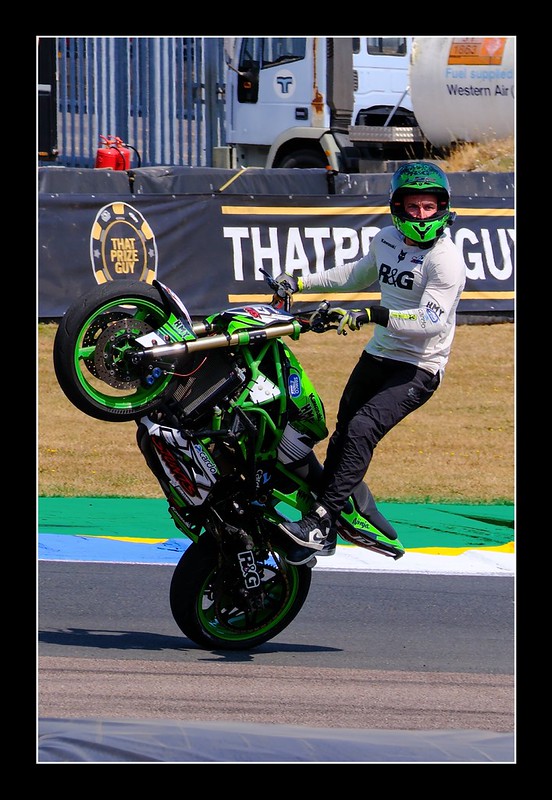
Sometimes the best photograph isn't the one you planned for! Keeping the camera ready and watching what is happening around the circuit can produce some memorable images.
Photographs like this also demonstrate why it is worth varying your approach during the day. Don't spend the entire time concentrating on one particular corner or using exactly the same camera settings.
Look around. Watch the racing. Anticipate what might happen next.
Choosing Your Camera Settings
There isn't one magic set of settings for motor racing photography.
Your shutter speed will depend on the effect you want to achieve, while aperture and ISO will need to be adjusted according to the available light.
For faster action, a shutter speed of 1/500 sec, 1/1000 sec or faster can be useful when the priority is freezing movement.
For panning, you might experiment with much slower speeds such as 1/250 sec, 1/125 sec or even slower.
The important thing is not to think of these figures as rules. They are starting points.
The best setting will depend on the speed of the subject, the direction it is travelling, your focal length and the effect you want to create.
Continuous autofocus can also be extremely useful when photographing rapidly moving bikes, particularly when the subject is approaching or moving away from you.
Finding the Best Positions Around the Circuit
One of the advantages of photographing at a circuit such as Thruxton is the variety of opportunities.
Different parts of the circuit produce completely different photographs.
At one location you might be looking to capture a single bike approaching at speed. At another, you might be concentrating on the way the riders lean into a corner.
And sometimes the best option is to step back and photograph several competitors together.
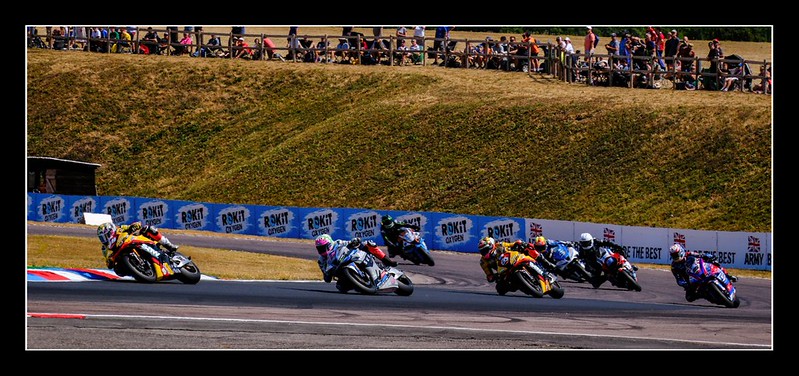
Photographing several bikes together can tell a very different story from an individual rider. It also gives a much better sense of the intensity of the racing.
It's also worth thinking carefully about the background.
A technically perfect photograph can be let down by a distracting background, while a slightly less obvious position can sometimes produce a much stronger image because the background is cleaner.
That's one of the things we concentrate on during our courses – not just how to take the photograph, but where to take it from.
Look for the Moments When the Riders Really Lean into the Corners
Motorcycle racing provides some fantastic opportunities to capture the skill and commitment of the riders.
At Thruxton, there are plenty of opportunities to photograph riders leaning heavily into corners, often with their knees almost touching the track.
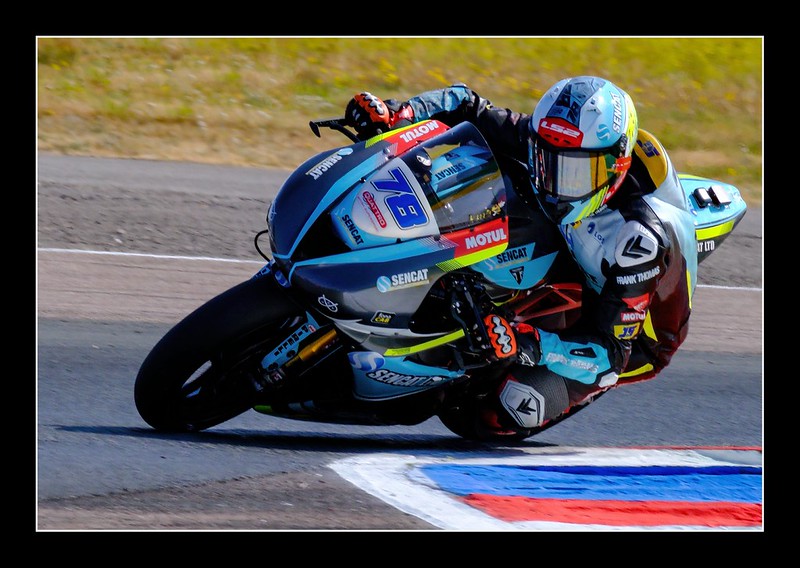
Getting low and filling the frame with the rider can produce a much more dramatic image. The position of the rider and bike tells the story of just how hard they are pushing through the corner.
This is where focal length and positioning become particularly important. A longer lens allows you to isolate the rider from the surroundings and concentrate attention on the action.
It also gives you the opportunity to capture details that you might miss when watching the racing with the naked eye.
Think About the Story as Well as the Action
Although the racing is obviously the main attraction, don't be afraid to vary your photography.
Look for groups of riders, unusual moments, the paddock, pit lane, spectators and all the other elements that contribute to the atmosphere of a race day.
Even when photographing the racing itself, try different compositions.
A tight photograph of a single rider can work extremely well, but a wider photograph showing several bikes negotiating a corner can give the viewer a much better idea of what it is actually like to stand beside the circuit.
The aim is to come home with a collection of photographs that tells the story of the day, rather than hundreds of almost identical shots.
The Satisfaction of Getting It Right
One of the reasons I enjoy teaching motor racing photography is that there is a real sense of achievement when everything comes together.
You've chosen the right position.
You've selected the right shutter speed.
You've followed the rider smoothly.
The autofocus has locked on.
And then, when you look at the photograph afterwards, you realise you've got the shot you were hoping for.
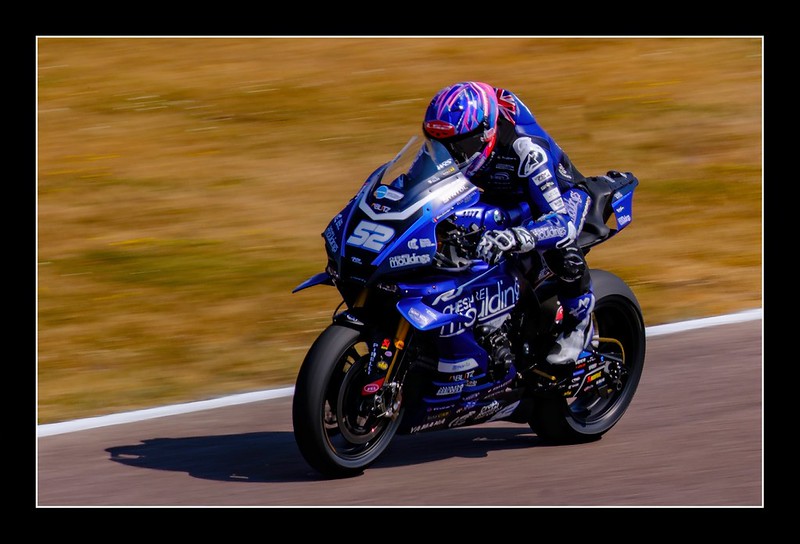
This is the sort of image we're aiming for on the course – a sharp subject, a blurred background and a strong feeling of movement.
Of course, it doesn't happen every time. That's photography!
But learning why a photograph worked – or why it didn't – is one of the quickest ways to improve.
What Happens on a FotoCourses Motor Racing Photography Course?
Our motor racing photography courses are designed to give photographers the opportunity to put these techniques into practice in a real racing environment.
Rather than simply spending the day watching someone demonstrate camera settings, the emphasis is on taking photographs yourself and getting help as you go.
We can look at your camera settings, explain autofocus options, discuss shutter speeds and panning techniques, and help you understand why some photographs work while others don't.
The aim isn't to send you home with a list of settings to memorise. It's to give you the confidence to make your own decisions when you're photographing motorsport in the future.
And, of course, there is plenty of time to photograph the action.
Fancy Giving Motor Racing Photography a Try?
If you've ever stood beside a racing circuit and thought, "I'd love to be able to photograph that properly," a motor racing photography course is a great way to get started.
You don't need to be an experienced motorsport photographer. You simply need a camera, a suitable lens and an enthusiasm for photography.
We'll help you with the rest.
Our motor racing photography courses give you the opportunity to photograph live racing while learning how to get more from your camera and improve your technique.
Whether you're completely new to motorsport photography or already have some experience and want to take your images to the next level, we'd love to have you along.
Want to Improve Your Motor Racing Photography?
Our motor racing photography courses give you the chance to photograph live racing while receiving practical guidance on camera settings, autofocus, panning, composition and positioning.
Whether you're new to motorsport photography or already have some experience, the courses are designed to help you get more from your camera and come away with photographs you are proud of.